What “Fair” Means in a Casino Game Dispute
Understand what “fair” means in a casino game dispute by separating equal treatment, clear terms, and consistent decisions to see what an explanation addresses.
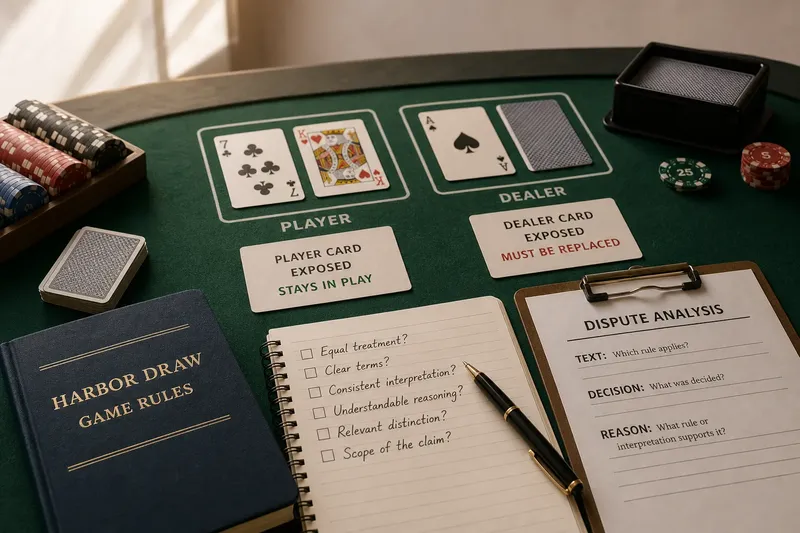
What does “fair” mean in a casino game dispute when someone offers the word as the whole explanation? In a fictional card game, one player may ask why a face-up card stays in play while another is set aside; the answer depends on what the rule covers and which kind of fairness is being claimed.
Fairness as a claim
“Fair” can describe several distinct concerns. A player might be asking whether comparable events receive comparable treatment, whether the terms were understandable before play, or whether a decision follows the rule as written.
Those questions do not answer one another. A rule may draw a distinction that applies to everyone, while a player still asks whether the distinction was clearly explained. Or the terms may be easy to read while leaving a particular event unaddressed.
- Equal treatment: Check whether the same stated standard applies to comparable situations; if it does, assess that consistency, and if it does not, ask what relevant difference explains the distinction.
- Clear terms: Check whether the rule addresses the event in question; if it does, compare the decision with its wording, and if it does not, ask what provision the decision-maker relies on.
- Consistent interpretation: Check how the same term is applied to similar events; if the explanations match, note that consistency, and if they differ, ask what difference in circumstances accounts for it.
- Understandable reasoning: Check whether the explanation connects a rule to the decision; if it does, identify that link, and if it does not, ask for the rule and reasoning separately.
- Relevant distinction: Check which facts the rule treats as different; if the decision names a relevant distinction, compare it with the text, and if it names none, ask why the outcomes diverged.
- Scope of the claim: Check whether “fair” refers to the wording, procedure, or outcome; if the speaker identifies one, discuss that claim, and if not, ask which concern they mean.
In legal education, this kind of close reading helps separate a word’s everyday force from the specific claim it is meant to support. It is an interpretive exercise, not a legal conclusion about a casino, its rules, or a particular dispute.
Ask which concern the word “fair” is meant to describe.
Rules and interpretation
A game’s written terms can tell players what a decision-maker is instructed to do, but they may not settle every question about how the rule was communicated or whether it covers an unusual event. A player’s reaction can point to a concern worth examining, but it does not, by itself, establish what the terms require.
For a focused discussion, keep three things distinct: the text, the decision, and the reason given for applying the text in that way. Then ask whether the reason refers to words the player can locate, an interpretation of those words, or an issue the terms leave open.
Write down the rule cited and the exact point it is said to resolve.
Questions about fairness?
Does fair mean every player has the same chance?
Not necessarily; in a dispute, the speaker may mean equal treatment, clear terms, or consistent application instead. Ask which specific claim the explanation addresses.
Can fairness settle an unclear rule?
The word alone cannot supply terms that are missing or decide how they apply. Separate the rule’s wording from the broader question of whether its presentation or use seems fair.
Does different treatment prove unfairness?
No; the events may differ in a way the stated terms recognize. If no relevant distinction is explained, the basis for the different decisions remains unclear, rather than proven improper.
What can a player do with a vague explanation?
Ask which rule applies, what part of its wording supports the decision, and what fact makes the case fit that rule. Those questions clarify the explanation without deciding a legal claim.
Comparing two events
Imagine Maya is playing a fictional card game called Harbor Draw. The posted rule says a player’s card exposed during the deal stays in play, but says nothing about a dealer’s exposed card. During a hand, a player’s card turns face up and remains in play; later, the dealer’s card turns face up and is set aside.
Maya starts with three pieces of information: the posted rule, the player-card decision, and the dealer-card decision. She asks the supervisor whether the posted rule covers both events. The supervisor points to a separate, fictional provision saying that an exposed dealer card must be replaced.
Maya now has a specific comparison: one provision addresses a player’s card, and another addresses the dealer’s card. She can check whether the separate provision is available and whether its wording matches the supervisor’s explanation. If it does, she can identify the stated basis for the different decisions; if it does not, she can ask what text or interpretation supports that distinction. Neither answer, by itself, settles the broader fairness question.
Keep the two decisions and the two cited rules side by side.
What remains unanswered
When someone calls a casino game fair, listen for the claim beneath the word. Is the concern equal treatment, readable terms, consistent application, or a particular outcome? A useful explanation should make clear which question it addresses.
The phrase “fair casino game dispute” can begin a careful inquiry, but it cannot replace the rule or the reasoning offered for a decision. The next useful move is to identify the principle being discussed and ask what the explanation leaves unresolved.