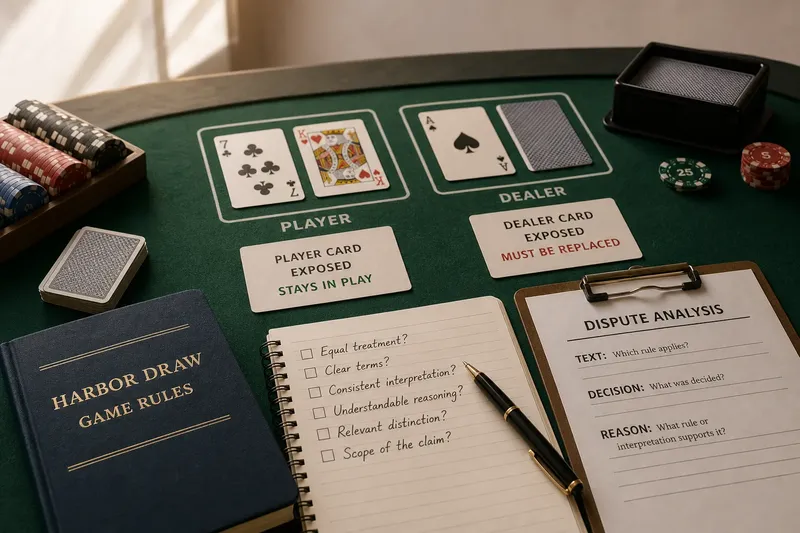
Fixed Game Instructions or Dealer Discretion: Who Decides the Next Move?
Fixed game instructions or dealer discretion can shape who controls a casino game's next move. Learn how to locate the applicable rule and clarify your options.

Who controls your next move when a casino rule and a dealer’s explanation seem to point in different directions? Fixed game instructions or dealer discretion can determine whether a player chooses, a dealer decides, or the answer remains unclear. The useful first move is to identify the exact decision at issue.
The Decision in Question
Rules can assign different parts of a turn to different people. A player might choose from listed options while a dealer handles the cards, announces the sequence, or records what happened. Those duties are not interchangeable: the relevant question is who has authority over this particular choice.
Start by describing the decision in plain language. Is the question whether an option is available, which available option to select, or how to carry out a selection already made? Separating those questions keeps a conversation from turning into a general argument about who is “in charge.”
Name the disputed choice before discussing the person who made the call.
Reading Game Terms
Look for the instruction that applies to the situation, including any posted terms or identified house policy. Note the condition that triggers the rule, the action it allows, and the role it names. If two instructions appear relevant, compare their wording and ask how the venue treats the overlap rather than assuming one automatically overrides the other.
A rule may assign a player a choice, or it may give a dealer judgment over a defined question. The practical distinction is what the text assigns and how far that assignment reaches. A dealer’s explanation can help clarify the procedure, but it does not by itself answer whether the stated rule gives that person the authority in dispute.
Keep the wording that matters in view, and ask for clarification before proceeding if its meaning is uncertain.
Rights and Recourse
It is reasonable to ask what options are available, how a decision is made, and where the applicable terms can be read. These are practical questions about expectations; they do not, on their own, establish a legal right or resolve whether a term is enforceable. Legal consequences depend on the setting and applicable law. If a consequential dispute arises, consult a qualified legal professional.
For students at Trường Đại học Luật TP. Hồ Chí Minh, a casino table can offer a concrete way to examine how institutions assign roles and explain decisions. A written rule may make an assignment easier to inspect, while an unclear rule can leave room for disagreement about its scope. The important analytical task is to distinguish the rule’s wording, the person applying it, and the effect on the player.
Questions About Table Rules?
How can I tell who chooses?
Find the instruction for the precise situation and check whether it assigns the choice to the player or another role. If the wording is unclear, ask the dealer to identify the applicable term before you act.
What if two rules seem to conflict?
Point to both instructions and ask which one the venue applies to the situation. If the explanation does not resolve the conflict, consider pausing rather than treating an uncertain answer as settled.
What should I ask the dealer?
Ask which posted rule or identified policy governs, what choice it leaves you, and who makes the disputed decision. A specific question is more likely to clarify the procedure than a broad challenge to the dealer’s authority.
Does a dealer’s decision settle a legal issue?
No table explanation alone establishes the legal effect of a term. If the issue has legal consequences, preserve the relevant wording and consult a qualified legal professional.
A Rule Comparison
Say you are considering two invented card-table formats. In Format A, the posted rule says the player chooses whether to request another card; in Format B, the invented rule says the dealer decides whether that option is available. You read each term, identify the decision it covers, and ask the dealer to explain how it applies. The resulting distinction is concrete: Format A assigns the choice to the player, while Format B assigns the availability decision to the dealer. The tradeoff is a direct player choice in one format and a more prominent dealer role in the other; these invented terms do not establish which format is fairer or legally valid.
Before You Proceed
- Check whether the rule names the decision-maker; if it names the player, ask how to exercise that choice, and if it names another role, ask what decision that role controls.
- Check whether the rule lists the available actions; if it does, compare your options before choosing, and if it does not, ask which actions are permitted.
- Check whether the dealer identifies a specific posted term or policy; if it matches the situation, compare the call with its wording, and if no source is identified, ask what instruction applies.
- Check whether the question is about an option’s availability or its selection; if it is availability, ask who decides whether it is offered, and if it is selection, ask who chooses among the permitted actions.
- Check whether the written term states limits on a role; if it does, ask how the decision fits those limits, and if the limits are unclear, request an explanation before continuing.
- Check whether the spoken explanation conflicts with the text; if it does, pause and ask how the venue resolves the conflict, and if the answer remains unclear, consider stopping before making a choice.
Fixed game instructions or dealer discretion becomes easier to assess when you isolate the decision, locate the applicable term, and ask how it assigns authority. If a player’s legal rights may be affected, a qualified professional can help assess the issue beyond the table’s explanation.