What a Game Rule Actually Does at the Table
See how a tabletop casino game rule defines allowed moves, handles unclear wording, and helps players reach a consistent ruling without personal disputes.
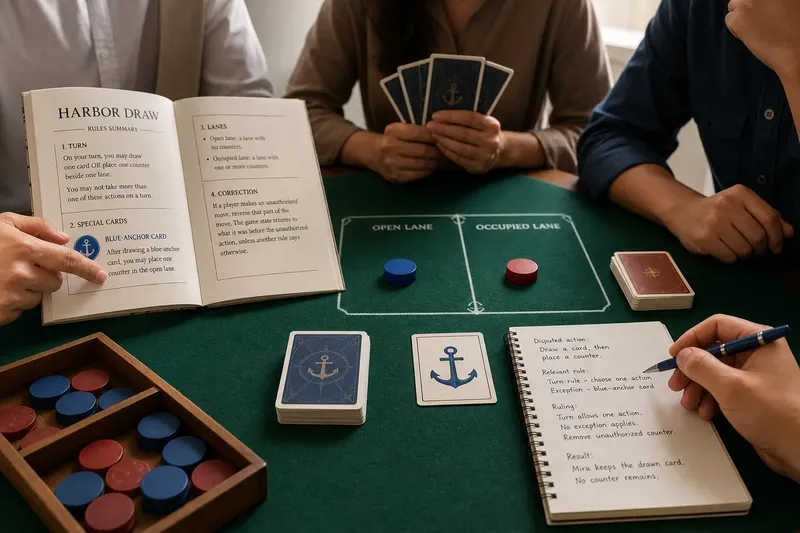
Can you draw a card and then place a counter, or does the rule allow only one move? A tabletop casino game rule answers by defining permitted actions and setting conditions. For students at Trường Đại học Luật TP. Hồ Chí Minh, a fictional table game can offer a focused way to examine how written rules shape choices and how shared procedures handle uncertainty.
Locate the disputed move
Imagine a fictional tabletop game called Harbor Draw. Players use cards and counters at a felt-covered table. On a turn, each player may either draw a card or place a counter beside one of two marked lanes. The written rules govern which moves count.
Before interpreting a disputed sentence, identify the exact moment in play. Is a player beginning a turn, choosing an action, revealing a card, or settling a round? A rule that applies “before a card is revealed,” for instance, does not automatically settle an action taken afterward.
State the disagreement in plain language. “Can Mira place a counter after drawing?” is more useful than “That feels wrong.” A precise question points to the relevant rule and keeps the discussion on the move, not the person.
Identify permitted actions
Look for verbs that grant or restrict an action: “may,” “must,” “choose,” “place,” “draw,” or “cannot.” Then check who the rule addresses and when it applies. A move allowed to the dealer during setup may not be available to a player during a turn.
In Harbor Draw, suppose the turn rule says, “A player may draw one card or place one counter.” The word “or” presents alternatives, while “one” limits each choice. Unless another rule creates an exception, the sentence does not allow a player to draw and then place a counter in the same turn.
Read the surrounding rules before treating that sentence as complete. A later clause might allow a player to place a counter after drawing a marked card. One rule can establish the ordinary move while another defines when it changes.
Write down the permitted actions before debating whether a move fits.
Check conditions and exceptions
Separate the general permission from its conditions. Words such as “only,” “unless,” “except,” and “if” often set boundaries. Ask what must be true for an action to be allowed, and whether another sentence narrows or overrides that permission.
Say a player draws a card marked with a blue anchor. Harbor Draw’s special rule says, “After drawing a blue-anchor card, the player may place one counter in the open lane.” That clause creates an exception to the ordinary choice between drawing and placing. It does not necessarily allow a counter in an occupied lane; the lane rule still matters.
Check the definitions, too. If “open lane” means a lane with no counters, use the game’s defined meaning rather than substituting an everyday one.
Resolve wording disputes
When two sentences appear to point in different directions, begin by asking whether one clearly defines an exception. If neither rule takes priority on its face, the text does not settle the question by itself; check the game’s stated dispute procedure before choosing a reading.
What if two rules seem to conflict?
Read both rules and look for language that makes one a specific exception to the other. If neither clearly takes priority, identify the conflict and use the game’s stated dispute procedure.
Does silence allow a move?
Not by itself. Check whether the rules list a closed set of permitted actions or leave players free to choose actions that are not prohibited; the wording and structure matter.
What should players do with ambiguity?
Pause the disputed action, read the relevant sentences aloud, and agree on an interpretation that fits the wording and applies consistently. If the rulebook names a decision-maker or tie-breaking procedure, follow it.
Can players settle the question for later rounds?
Players can agree on a consistent house interpretation if it does not contradict a rule the game treats as mandatory. Record the decision so the same wording does not produce a different ruling for the next player.
Apply the ruling evenly
Once the table identifies the relevant rule, state the ruling and connect it to the text: “The turn allows one action, and the blue-anchor exception does not apply, so the counter stays off the lane.” That explanation shows what mattered and gives the player a clear reason to continue.
Then follow the game’s correction procedure, if it has one. The rules may say to reverse an invalid move, leave the board unchanged, or restart part of the turn. Do not invent a penalty because the group is frustrated; a consequence should come from the rules or an agreed house rule.
Imagine Mira’s turn begins with an empty board, a hand containing one ordinary card, and no counters on either lane. She draws the ordinary card, then places one counter in the left lane. The group reads the turn rule, confirms that it allows a draw or a counter placement, and checks that the card does not trigger the blue-anchor exception. A separate correction clause says to remove an unauthorized counter before play resumes, so the group removes it and leaves the drawn card with Mira. The visible result is one card in her hand and no counter from that turn; the decision follows the fictional rule text, not an accusation about Mira.
Check the rule in practice?
Which words define a permitted action?
Look for terms such as “may,” “must,” “or,” and “cannot,” then identify the actor and the moment the rule covers. If the sentence leaves either unclear, read the surrounding clause before deciding what the player may do.
How can players spot an exception?
Search for “if,” “unless,” “except,” and “after,” then compare that condition with the ordinary turn rule. If the stated condition is absent, use the ordinary rule unless another clause says otherwise.
What should happen when the rules stay unclear?
Pause, state the exact disputed action, and consult any named decision-maker or tie-breaking procedure. If none exists, agree on a consistent house interpretation and record it as a table choice, not printed text.
How can a group keep its ruling consistent?
Write down the wording at issue, the interpretation chosen, and the point in play where it applies. If a later rule changes the situation, revisit the note instead of extending the earlier ruling automatically.
Keep rules usable
When a sentence repeatedly causes confusion, clarify it for future games. Name the actor, timing, permitted action, and exception. For example: “During a turn, a player may draw one card or place one counter, but not both. After drawing a blue-anchor card, the player may also place one counter in an open lane.”
Keep the original rule visible when playing an established game, and mark any house interpretation as a group choice rather than printed text. The distinction matters: one is the game’s written rule, while the other records how the table handles an unresolved point.
This tabletop casino game rule analogy can help students examine how wording, choices, and shared procedures interact. It does not decide real rights or obligations. For a question about an actual legal matter, seek guidance from a qualified legal professional; for a game dispute, return to the exact clause and record any house interpretation clearly.