Casino Law in Cultural Imagination: Private Rooms and Public Spectacle
Casino law in cultural imagination helps you read who controls a gaming scene and what it suggests, while keeping fictional portrayals distinct from legal evidence.
Does a casino scene in a novel tell you what the law allowed? Casino law in cultural imagination is a useful lens for asking who controls entry, who gets watched, and how a work portrays authority. For students at Trường Đại học Luật TP. Hồ Chí Minh, the distinction matters: a scene can frame a legal question without establishing the law of a particular place or period.
Doors and access
A private room puts control of entry in plain view. A host may invite selected guests, a club may admit members, or a household may keep play behind closed doors. In a story, each arrangement can suggest status or secrecy. It also raises a practical question: whose permission matters?
Notice how entry works. Is it by invitation, membership, payment, or open access? Does a host, doorman, or official make the decision? Those details support an interpretation of power in the scene; they do not establish what an actual institution was legally entitled to do.
When a doorman appears, ask whose decision he carries out—and whether the work makes that authority clear.
Crowds and spectacle
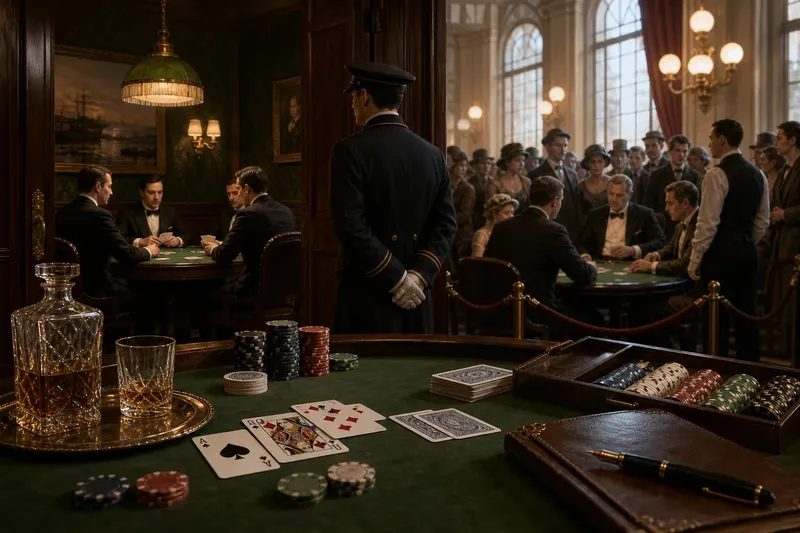
When people beyond the players watch, a game becomes a public performance in the story: a contest of nerve, a display of wealth, or entertainment. The audience can bring reputation, staff management, and the venue’s standing into the drama.
Imagine an invented novel in which the same card game moves from a rented private room to a busy hotel lounge. The players and cards stay the same; strangers can now watch, and staff appear to manage the space. The observable change is the wider audience. It does not show that gambling became more accepted or that the law changed; those claims would need evidence tied to the relevant place and period.
A crowd can make a game look like entertainment while also exposing who controls the room and who is being watched.
Portrayal and legal evidence
A uniform at the door, a notice on a wall, or an official visit can make authority feel present in a scene. Those details show how a work represents power; by themselves, they do not establish the terms of a law, permit, or restriction.
Use these checks to keep interpretation distinct from a claim about law:
- Setting: Check whether the work names a home, club, hotel, or city. If it names a location, seek sources tied to it; if it does not, avoid assigning the scene a specific legal setting.
- Access: Check for invitations, membership, payment, guards, or open entry. If a gatekeeper appears, describe the control shown; if access is unclear, do not invent a rule.
- People: Check who plays, hosts, works, watches, or acts in an official role. If the work shows who decides, identify that portrayal; if it does not, say the decision-maker is unclear.
- Language: Check for words about leisure, vice, risk, respectability, or disorder. If characters disagree, distinguish their views; if the work offers no judgment, do not attribute one to it.
- Objects: Check for a permit, notice, uniform, locked door, or official visit. If the work links an object to authority, explain that implication; if its meaning is uncertain, leave the legal claim open.
- Historical context: Check the stated date and location against relevant sources. If sources support the context, limit your claim to what they establish; if they disagree or leave a gap, report the uncertainty.
- Your claim: Check whether your sentence describes the work or asserts a fact about law. If relevant evidence supports the legal claim, identify its basis; if not, recast the sentence as an interpretation.
Keep three layers separate: what the work depicts, what you interpret it to suggest, and what relevant legal or historical sources can establish. For a question with real legal consequences, consult a qualified legal professional.
Questions about casino scenes?
Does a public casino scene mean gambling was legal?
No. A visible venue in a story shows how its creator chose to portray public life, not the legal status of gambling in a specific jurisdiction. Check sources for the relevant place and period before making a legal claim.
Why do stories use private gaming rooms?
A private room gives writers a compact setting for invitations, social rank, secrets, and conflict. It also makes control over entry and conduct easy to see.
What changes when a crowd watches?
The game gains an audience beyond its players, making reputation and management more prominent in the scene. That may suggest spectacle, but it does not establish a historical or legal shift.
Can a film or novel establish casino law?
A work can reveal assumptions and arguments about authority, access, and morality, but it cannot establish legal rules on its own. Use it to frame questions, then consult relevant legal texts and historical sources.
A worked reading
Say you choose an invented story set in a port city. At the start, its card game has four named members behind a club’s closed door; later, the same game appears in a public lounge, where three staff members and six watching strangers are described. These are hypothetical details from the invented story, not historical counts.
First, record the starting scene: four members, a closed club door, and no stated legal rule. Next, record the later scene: the same four players, three staff members, six observers, and no clear rule about the lounge. Then consult sources for the city and period named in the story. Imagine those sources establish a rule about club entry but do not address gaming in hotel lounges. The resulting answer is narrow: the story contrasts controlled club access with a wider audience, while the lounge’s legal status remains unestablished. If the sources instead addressed both settings, you could compare their documented rules; if they did not identify the city or period reliably, you would leave the legal context unresolved.
The tradeoff is a less sweeping claim and a clearer boundary between fiction and evidence. If the work gives no reliable date or location, preserve that uncertainty rather than fitting it to a familiar timeline.
Different historical paths
Casino law in cultural imagination does not describe a universal journey from private rooms to public spectacle. Some works present public entertainment as ordinary; others return to hidden rooms even in crowded urban settings. A story may celebrate spectacle while emphasizing controlled entry, or make private play matter beyond the room. Those contrasts help readers see how a work frames authority without treating one image as a history for every society.
Describe the scene, identify who controls access, and separate artistic implication from legal evidence. A door, a crowd, and a watching official can show where a story places authority; relevant sources are needed to establish what authority could actually do.